

Call Now For Help With Squirrels
Squirrels in North Carolina: Species, Behavior, and Attic Damage
North Carolina is home to five tree squirrel species. The eastern gray squirrel (Sciurus carolinensis) is the most common and was adopted as the official state mammal in 1969. It is found in every county. The eastern fox squirrel (Sciurus niger) is the largest tree squirrel in the state, roughly twice the size of the gray. The red squirrel (Tamiasciurus hudsonicus) is limited to the higher elevations of western North Carolina. The remaining two species are the southern flying squirrel and the Carolina northern flying squirrel, both of which are nocturnal and covered in a separate profile.
When homeowners in the Piedmont and Coastal Plain call about squirrels in the attic, they are almost always dealing with the eastern gray squirrel. It is the species most adapted to suburban and urban environments, the most comfortable around human activity, and the most aggressive about entering buildings. Gray squirrels are active during daylight hours, which means the scratching, thumping, and gnawing they produce in an attic is at its worst during the early morning and late afternoon – exactly when homeowners are home to hear it.
Biology and Physical Characteristics
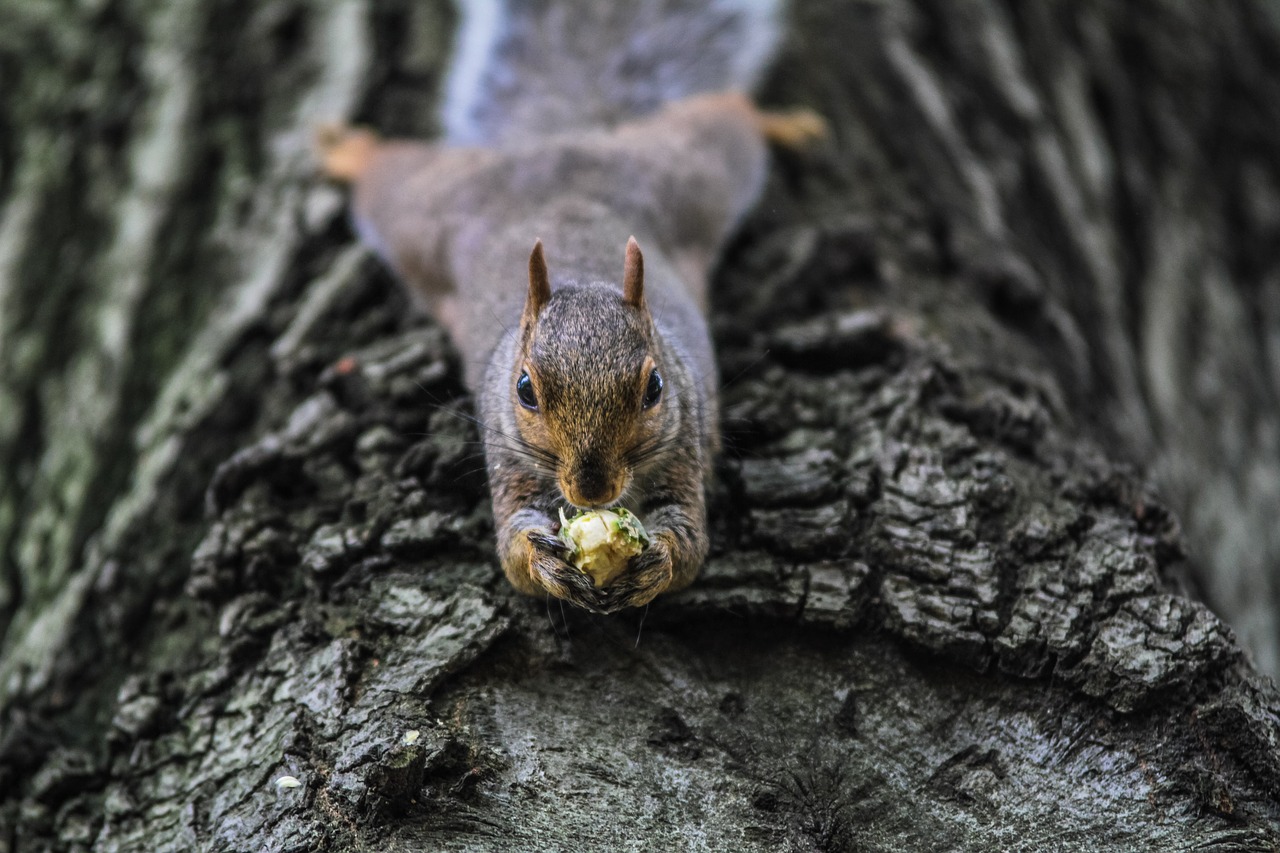
The eastern gray squirrel measures 15 to 20 inches from nose to tail tip and weighs 10.5 to 25 ounces. The fur is typically grayish-brown on top with a whitish belly and a conspicuously bushy tail. Color variation exists – some individuals are yellowish-gray, silvery gray, or even reddish, and melanistic (black) and albino (white) gray squirrels occur occasionally in certain populations across the state.
The fox squirrel is noticeably larger, measuring 20 to 26 inches and weighing 1.5 to 2.6 pounds. Its coloration is the most variable of any North Carolina squirrel, ranging from grayish with black patches on the head and white patches on the nose and ear tips, to almost entirely black, to reddish or rust-colored. Fox squirrels prefer open, mature pine-oak forests and are less common in suburban settings than gray squirrels, though they do enter structures in rural areas.
| Species | Length | Weight | Range in NC | Habitat |
|---|---|---|---|---|
| Eastern Gray Squirrel | 15-20 inches | 10.5-25 oz | Statewide, every county | Hardwood forests, suburban yards, urban parks |
| Eastern Fox Squirrel | 20-26 inches | 1.5-2.6 lbs | Piedmont and Coastal Plain, expanding in NW mountains | Mature pine-oak forests, open woodlands |
| Red Squirrel | 11-14 inches | 5-9 oz | Western NC mountains only | Coniferous and mixed forests at higher elevations |
Like all rodents, squirrels have continuously growing incisor teeth that require constant gnawing to wear down. This biological trait is the direct cause of the structural damage they inflict on buildings. They do not gnaw because they are hungry or destructive by nature. They gnaw because their teeth do not stop growing, and hard materials – including wood framing, fascia boards, vinyl siding, plastic vent covers, and electrical wiring insulation – serve as filing surfaces.
Reproduction and Young
Eastern gray squirrels breed twice per year. The first breeding period occurs in mid-winter, typically January through February. The second runs from late May through July. Gestation lasts 40 to 45 days. Litters average 3 to 4 pups but can range from 1 to 8. Females may produce one or two litters per year depending on food availability – in years with heavy acorn production, two litters are more common.
Pups are born hairless and blind, weighing roughly half an ounce. Their eyes open at about five weeks, and they are weaned by two months. Young squirrels begin venturing outside the nest at around 10 to 12 weeks, though they may continue using the natal den for several more weeks.
Females strongly prefer enclosed cavities for birthing and raising young. In the wild, this means tree cavities – old woodpecker holes, knotholes, and hollow trunks. In suburban areas, attics serve as the next best option. A gray squirrel that enters an attic in January or February is very likely a pregnant female selecting a maternity den. She will have her litter there, raise the pups for two to three months, and may use the same den for her second litter in the summer. This means a squirrel that gains access to an attic in winter can be an occupant through the fall.
Fox squirrels follow a similar reproductive schedule. They generally breed in mid-winter, with litters of 2 to 4 young born in February or March after a 44 to 45 day gestation. Older females in good condition may produce a second summer litter in years with abundant food.
Seasonal Behavior and Habitat
Gray squirrels are diurnal and active year-round. They do not hibernate. Activity peaks in the early morning and late afternoon, with a midday rest period during warmer months. In winter, they may compress their activity into the warmest hours of the day.
Gray squirrels thrive wherever hardwood trees provide mast (nuts). Acorns, hickory nuts, walnuts, and pecans are the staple of their diet, supplemented by seeds, fruits, mushrooms, tree buds, flower blossoms, insects, and occasionally bird eggs and nestlings. They are prolific cachers, burying nuts individually throughout their home range during fall. Many of these caches are never retrieved, making gray squirrels one of the most effective – if unintentional – planters of hardwood trees in the eastern United States.
Their home range in suburban settings is typically 1 to 7 acres, centered on food sources and den sites. In neighborhoods with mature oaks, hickories, and bird feeders, gray squirrel densities can be remarkably high. The NC State Extension notes that urban yards with bird feeders are prime habitat for gray squirrels, and that removing or securing feeders is one of the most effective ways to reduce squirrel activity around a home.
Gray squirrels build two types of nests: leaf nests (called dreys) constructed of twigs and leaves in tree forks, and cavity dens inside hollow trees. Cavity dens provide far better protection from weather and predators and are strongly preferred for raising young. When natural cavities are in short supply – as they are in younger suburban tree canopies – attics become the next best cavity.
Why Squirrels Become a Nuisance
The eastern gray squirrel is the most common nuisance wildlife species that homeowners in North Carolina’s Piedmont and suburban areas deal with. The NCWRC identifies three primary categories of conflict: presence in homes, chewing behavior, and garden and bird feeder raiding.
Attic intrusions. Gray squirrels access attics by climbing trees to the roofline and entering through existing gaps or by gnawing new openings. They can jump 8 to 10 feet horizontally from a tree branch to a roof. Once on the roof, they target vulnerable points – the soffit-to-fascia junction, ridge vents, gable vents, and the gaps where roof sheathing meets the wall plate. Unlike flying squirrels, which tend to use existing gaps, gray squirrels actively enlarge openings by chewing. A hole that starts as a small construction gap can be widened to 3 or 4 inches within days.
Structural gnawing. Inside the attic, squirrels gnaw on wood framing, rafters, stored items, PVC plumbing, and anything else within reach. They tear up insulation for nesting material. They cache food in insulation and wall voids. The accumulated damage from a squirrel that has been in an attic for a full breeding season – roughly January through August – can be extensive.
Noise. Gray squirrels are loud. Their movement across attic joists and through insulation produces heavy thumping and scrambling that is audible from the rooms below. They are vocal animals as well, producing barks, squalls, chattering, and tooth grinding. Because they are diurnal, the noise is concentrated during the hours when homeowners are awake and aware of it, making it more disruptive than the nighttime activity of flying squirrels or rats.
Exterior damage. Gray squirrels chew on wooden siding, window trim, deck railings, outdoor furniture, and drainage pipes. They strip bark from ornamental trees and shrubs. NC Wildlife Resources Commission documentation and Extension publications both cite damage to thin-barked trees, where squirrels strip horizontal bands of bark often five feet or more above ground level.
Electrical Wiring Damage: The Fire Risk in Your Attic
Of all the damage squirrels cause inside a structure, chewing on electrical wiring is the most dangerous. A gnawed fascia board is a repair bill. A gnawed wire inside a wall is a potential house fire.
Squirrels chew on wiring for the same reason they chew on everything else: their incisors never stop growing. The thermoplastic insulation on electrical wire is a firm, satisfying material to gnaw, and wiring runs through attics and wall voids directly through squirrel travel routes. A squirrel does not target wiring specifically – it gnaws on whatever is available along its path. But wiring is consistently in that path, and the consequences of chewed wiring are more severe than the consequences of chewed wood.
When the insulation is stripped from a wire, the bare conductor is exposed. Inside an attic, that exposed wire may contact wood framing, insulation batting, or another bare wire. Any of those contact scenarios can produce arcing, sparking, or sustained heat sufficient to ignite surrounding materials. The fire starts inside the wall or attic space, where it may not be detected until it has spread.
Older homes are at higher risk. Cloth-insulated wiring from the mid-20th century is more fragile and easier for squirrels to damage than modern NM (Romex) cable, and older wiring is less likely to be protected by arc-fault circuit interrupter (AFCI) breakers that can detect the electrical anomalies caused by damaged wiring. But newer construction is not immune. Any wire that a squirrel can reach and chew is a potential fire source.
After any squirrel infestation in an attic or wall void, having an electrician inspect the wiring in the affected area is a reasonable precaution. The cost of an inspection is trivial compared to the cost of an electrical fire that starts in an inaccessible space.
Health Risks Associated with Squirrels
Gray squirrels are not classified as rabies vector species in North Carolina, and the direct disease risk from squirrels is lower than from raccoons or bats. However, several health concerns are associated with squirrel infestations in buildings:
Ectoparasites. Squirrels carry fleas, ticks, and mites. When a squirrel colony is living in an attic, their ectoparasites accumulate in nesting material. After the squirrels are removed or excluded, parasites that remain in the attic may migrate into living spaces seeking new hosts. Flea infestations in bedrooms and living areas that seem to appear out of nowhere sometimes trace back to a former squirrel nest in the attic above.
Salmonella. Squirrel droppings can carry Salmonella bacteria. Accumulated fecal material in an attic, on stored items, or in insulation poses a contamination risk, particularly if particles become airborne during cleanup or renovation.
Leptospirosis. Squirrel urine can contain Leptospira bacteria. Insulation saturated with urine in an attic space is a potential exposure source, especially when disturbed without respiratory protection.
Fungal contamination. Accumulated droppings and urine in enclosed attic spaces create conditions that can support fungal growth, similar to (though less severe than) the histoplasmosis risk associated with bat guano. Proper respiratory protection should be worn when entering a squirrel-contaminated attic for cleanup or inspection.
Legal Status and Regulations in North Carolina
The eastern gray squirrel and the eastern fox squirrel are both classified as small game species in North Carolina with established hunting seasons and bag limits. Landowners do not need to purchase a hunting license to take squirrels on their own property during the open season.
Outside of hunting season, squirrels causing property damage can be addressed through several channels. The NCWRC allows homeowners to obtain a depredation permit from a Wildlife Enforcement Officer or District Biologist, which authorizes trapping and removal of squirrels causing property damage. Alternatively, a licensed Wildlife Control Agent (WCA) can be hired to handle removal. Unlike raccoons, squirrels are not classified as rabies vector species and can be relocated – but relocation must be onto private property with the landowner’s permission.
The NCWRC recommends trimming tree limbs back at least 6 feet from the residence as the single most effective preventive measure against squirrel entry. This eliminates the launching platform squirrels use to jump from trees to rooflines. Sealing entry points with half-inch hardware cloth or heavy-gauge screen prevents reentry through existing gaps.
Common Entry Points on Structures
Soffit-to-fascia junction. The most common entry point. Squirrels gnaw at the intersection where the soffit panel meets the fascia board, particularly at corners where materials join. Wood rot at this junction makes entry easier, but squirrels will chew through sound wood as well.
Gable vents. The louvered vents in the gable ends of the attic. Factory aluminum or fiberglass screening behind the louvers is easy for squirrels to push through or chew apart. Metal hardware cloth is the only screening material that reliably excludes squirrels.
Ridge vents. Gaps where ridge cap sections meet, or where the ridge vent material has deteriorated, provide access to the attic space directly at the peak of the roof.
Roof-wall intersections. Where a lower roof meets an upper wall (common on two-story homes with bump-outs or additions), the flashing and trim details create seams that squirrels can exploit.
Plumbing vent stacks. The PVC pipes that protrude through the roof for plumbing ventilation. Squirrels sometimes gnaw the rubber boot seal around these pipes, opening a gap into the attic.
The NCWRC emphasizes that the tree canopy is the access route. If branches within jumping distance (8 to 10 feet) of the roof provide a launch point, squirrels will reach the roofline regardless of how well the entry points are sealed. Exclusion without tree trimming is often a temporary fix.
Signs of Squirrel Activity
Daytime noise in the attic. This is the signature indicator. Heavy scurrying, thumping, and scratching during the early morning and late afternoon – concentrated during daylight hours – points to gray squirrels. Nighttime-only noise more likely indicates flying squirrels or rats.
Chew marks at the roofline. Freshly gnawed wood on fascia boards, soffit panels, or trim near the roof edge. The chew marks are rough and uneven, with visible tooth impressions. Fresh gnawing produces light-colored exposed wood; older damage darkens with weathering.
Droppings. Squirrel droppings are small, oblong, dark-colored pellets similar in size to rat droppings but slightly more rounded. They accumulate near entry points, along travel routes in the attic, and around nesting areas. Quantities build up over time – an attic that has been occupied for months will have droppings scattered broadly across the insulation.
Nesting material. Shredded insulation, leaves, bark strips, and other debris gathered into a rough nest, usually in a corner of the attic or against a wall near the entry point. Squirrels also cache food in insulation and wall voids – finding acorns or hickory nuts buried in your attic insulation is a definitive squirrel indicator.
Visible squirrels on the roof. Gray squirrels are active during the day and are not particularly secretive about their movements. Watching squirrels run along the roofline and disappear into a specific gap is the most direct way to identify both the species and the entry point.
The Role of Squirrels in the Ecosystem
The eastern gray squirrel is one of the most ecologically important mammals in North Carolina’s hardwood forests. Their habit of caching thousands of acorns and nuts each fall – and failing to retrieve a significant percentage of them – makes them a primary agent of forest regeneration. Every oak tree that grew from a forgotten acorn cache is, in a sense, a squirrel-planted tree. This seed dispersal function is so significant that forest ecologists consider gray squirrels a keystone species in eastern hardwood forests.
Squirrels are also a critical food source for hawks, owls, bobcats, foxes, coyotes, and black rat snakes. Gray squirrels are the most commonly hunted small game species in North Carolina and have been an important part of the state’s outdoor heritage for centuries.
The North Carolina Wildlife Federation notes that the gray squirrel’s omnipresence earned it the distinction of state mammal, but that same adaptability is what puts it in conflict with homeowners. The animal that plants forests and feeds raptors is the same animal that chews through your fascia board and nests in your attic insulation. The solution is not to eliminate squirrels from the environment but to keep them on the right side of the building envelope. Trimming trees back from the roofline, sealing entry points with durable materials, and removing food attractants around the home allow the species to continue doing its ecological work without doing it inside your house.